


Hospital-to-outpatient transition and discharge process for stroke patients at tertiary care level hospitals in Peru
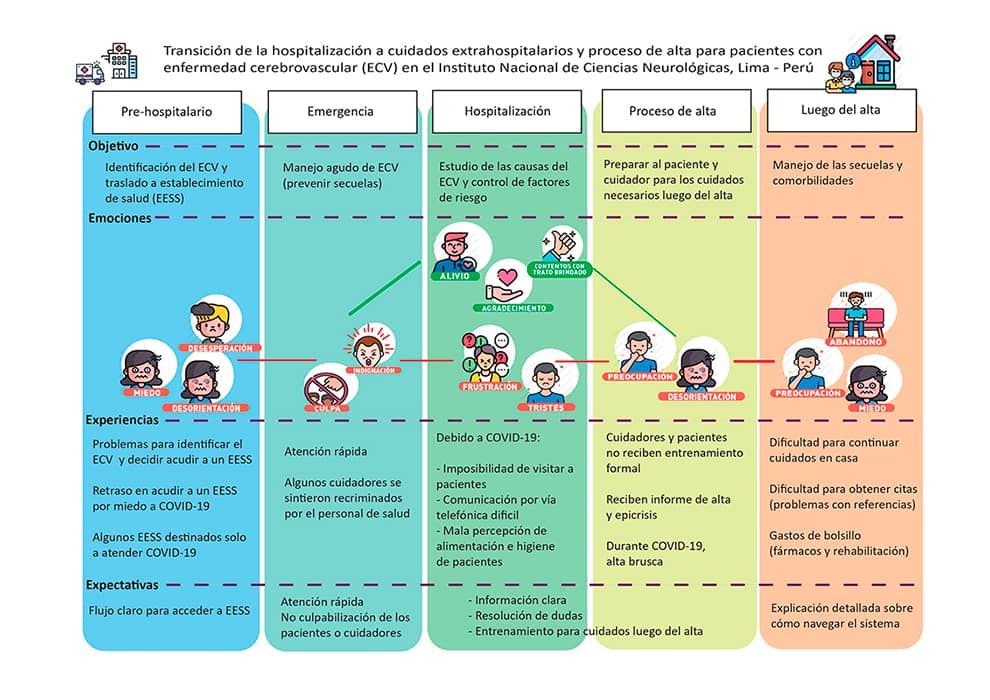
Post-discharge care for patients with stroke is important because it prevents the development of re-stroke and reduces the severity of the sequelae. However, post-discharge care involves different healthcare providers at different levels of the system. The continuity of care for chronic diseases has been affected by the restructuring of health services in response to the COVID-19 pandemic.
Aim:
Understand the transition from hospital to out-of-hospital care (continuity of care) of patients with stroke treated in a third-level facility before and during the COVID-19 pandemic.
Study design:
Qualitative study, carried out between February and March 2021, which consisted of in-depth interviews with patients, caregivers, and health professionals involved in the management of CVD in a third-level facility in Lima, Peru.
Result:
Eleven interviews were conducted with patients with stroke and their families and 8 with health workers. The search for stroke care was delayed because patients were afraid of getting sick with COVID-19 when visiting a hospital and, because some health facilities were only dedicated to treating patients with COVID-19, there were delays in reaching an establishment that can provide care. During hospitalization, communication between family members and health personnel was affected by restrictions on the admission of family members to the hospital; some caregivers stated that they had not received information, while others communicated by telephone in a concise manner, which did not allow questions to be asked and to clarify doubts from family members. No training was provided to patients or relatives to continue care at home, for example, mobilization of the patient, etc. In addition, due to the limited number of appointments or problems with referrals, there were difficulties in accessing follow-up appointments and rehabilitation therapy, so some patients went to private clinics. The interviewees provided recommendations focused on improving communication between patients and healthcare providers, as well as between providers, and stressed the need to improve the referral system to optimize continuity of care.
Transición de la hospitalización
Contact:
Jessica Hanae Zafra-Tanaka, MD, MSc
jessica.zafra@upch.pe
Place of study
Lima, Perú.
Funding
Fogarty International Center (NIH Research Training Grant D43:TW009345) through the Northern Pacific Global Health Research Fellows Training Consortium.
Duration of the study
2020-2021
Reserachers
Jessica Hanae Zafra-Tanaka
Jill Portocarrero
J Jaime Miranda
Collaborators
Carlos Abanto, Centro de Investigación en Enfermedad Cerebrovascular, Instituto Nacional de Ciencias Neurológicas, Lima, Perú.
Joe Zunt, Department of Global Health, University of Washington, Seattle, United States.
Publications
- Zafra-Tanaka JH, Portocarrero J, Abanto C, Zunt JR, Miranda JJ. Managing Post-Stroke Care During the COVID-19 Pandemic at a Tertiary Care Level Hospital in Peru. J Stroke Cerebrovasc Dis. 2022 Apr;31(4):106275. doi: 10.1016/j.jstrokecerebrovasdis.2021.106275. Epub 2021 Dec 24. PMID: 35121533; PMCID: PMC8702405. https://pubmed.ncbi.nlm.nih.gov/35121533/
News
Videos
Gallery