


Addressing the double burden of malnutrition in Peru: using a community-based system dynamics approach to improve food systems
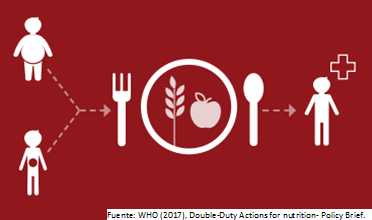
The Double Burden of Malnutrition (DBM), which is the coexistance of undernutrition and overnutrition, is a publich health problem in Peru. Undernutrition has been a permanent problem in Peru, although the prevalence of stunting has remarkably decreased, the prevalence of anaemia still high. At the same time, overnutrition problems such as obesity and the development of non-communicable diseases have increased. Thus, addressing both is important, and the role of food systems is fundamental for it, because it includes all the processes that operate to feed the population, which can simultaneously affect food security , diet quality and health. Even though Peru has undertaken acctions to address malnutrition, those have a one-sided focus targeting either under- or over-nutrition and failing to address both simultaneously due to the lack of double-duty policies, meaning actions that aim to simultaneously address the common drivers of malnutrition in all its forms. Therefore, this study is focused on addressing the DBM in Peru through common population level interventions in food systems, using an innovative approach named Community Based System Dynamics (CBSD) that will facilitate policy prioritization and policy evaluation to combat DBM in Peru.
Aim:
To understand the drivers of the food system that contribute to the double burden of malnutrition across three diverse regions in Peru and identify effective policies that address it, using innovative community-based systems approaches.
Study design:
The study will be carried out through 4 work packages (WP). The WP Nº1 considers the training of researchers and stakeholders on the subject of CBSD through seminars leading by experts, and CBSD workshops with local stakeholders that will be held in three regions of Peru: Lima, Tumbes and Huancavelica. The WP Nº2 includes the development of a system dynamics simulation model to quantify the food system drivers of the DBM in Peru and the participation of a systems thinking network conformed by stakeholders. The WP Nº3 considers the use of a system dynamics simulation model to quantify the effect of different policy scenarios on DBM in Peru, with the participation of policy makers and the community. Finally, the WP Nº4, considers meetings that will be held to achieve consensus with stakeholders to prioritise and communicate policy recommendations report.
Result:
Project currently ongoing.
Contact:
Antonio Bernabé-Ortiz, MD, MPH, PhD
antonio.bernabe@upch.pe
Place of study
Lima, Tumbes y Huancavelica
Funding
Biotechnology and Biological Sciences Research Council
Duration of the study
2021-2024
Reserachers
Antonio Bernabé-Ortiz
J Jaime Miranda
Carmen Quinteros Reyes
Collaborators
Miluska Carrasco, Programa Nacional de Innovación Agraria, Ministerio de Agricultura e Irrigación.
María Mercedes Tang Tong, Universidad San Ignacio de Loyola
Christopher Millet, Imperial College London
Paraskevi Seferidi, Imperial College London
Jonathan Pearson-Stuttard, Imperial College London
Martin O’Flaherty, University of Liverpool
Marc Suhrcke, University of York
Publications
- Seferidi P, Hone T, Duran AC, Bernabe-Ortiz A, Millet C. Global inequalities in the double burden of malnutrition and associations with globalisation: a multilevel analysis of 55 low- and middle-income countries 1992-2018. Lancet Glob Health . 2022 Apr;10(4):e482-e490. Epub 2022 Feb 8. https://doi.org/10.1016/s2214-109x(21)00594-5
- Laura Guzman-Abello, Ellis Ballard, Hilary M. Creed-Kanashiro, Luis Huicho, J Jaime Miranda, Christopher Millett, Antonio Bernabe-Ortiz. Actions against the double burden of malnutrition in Peru: a community-informed system dynamics model. The Lancet Regional Health – Americas 2025;46: 101102. https://doi.org/10.1016/j.lana.2025.101102
News
Videos
Gallery