


Cooking for health: capitalizing on community kitchens to bring healthy diets to low-income families in Peru for the prevention of non-communicable diseases
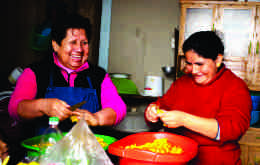
Community kitchens (comedores populares) are a perfect setting for the implementation of well-designed and culturally sensitive interventions to promote healthy eating habits and reducing the risk for developing chronic diseases among the poor population of Lima.
Aim:
Promoting the adoption of healthy eating habits among low-income population of urban communities as members, suppliers and/or consumers, of Lima’s community kitchens.
Study design:
The project involved three consecutive studies:
(1) A qualitative study to undestand the performance of community kitchens and explore the odds for promoting a healthier diet. Four week-long observations and 68 interviews were conducted with cooks, members, and non-members of four community kitchens, as well as fruit and vegetable vendors.
(2) A discrete choice experiment to explore the preferences of 432 users from 48 popular community kitchens when choosing their menus and knowing their willingness to buy healthier menus.
(3) An intervention to promote the sale and consumption of fruits and salads in community kitchens.
This intervention was carried out in twelve kitchens in Lima, six in San Juan de Miraflores and six in Cercado de Lima. In each district, two canteens sold fruit, two sold salads, and two did not change their menu. The cooks of the intervention canteens took from four to six training sessions, for one and a half months, in topics of general nutrition and properties of fruits and vegetables, hygiene, sales and leadership, and salad preparation. After this period, the participating kitchens offered their diners fruits or salads along with the usual menu, for nine weeks. The sale of fruits and salads was preceded by a small marketing campaign to promote their consumption among diners. A detailed record of food sales was made throughout the intervention.
Result:
The qualitative study and the discrete choice model allowed us to know in depth the performance of community kitchens, the preferences of the members and diners, and the opportunities and barriers for the intervention stage. The twelve community kitchens participating in the intervention stage concluded the project demonstrating commitment and having to overcome the barriers that their limited resources impose on them. During the nine weeks of the intervention, 6,853 servings of fruit and 2,653 120gr salads were sold in eight community kitchens, for a total of 9,506 servings of fruit and salads sold.
A few weeks after the intervention ended, most of the community kitchens involved (seven out of eight) continued to sell fruit or salads using their own resources. Some local institutions that work with the participating kitchens expressed interest in learning about the project and expanding it to other community kitchens.
Contact:
Francisco Diez Canseco, MPH
fdiezcanseco@upch.pe
Place of study
Distritos de San Juan de Miraflores y Cercado de Lima, Perú.
Funding
International Development Research Centre
Duration of the study
2012 – 2014
Reserachers
J Jaime Miranda
Francisco Diez Canseco
Antonio Bernabe-Ortiz
Carla Martínez
Lizzete Najarro
Rocío Gálvez
Lorena Saavedra
José Alfredo Zavala Loayza
Collaborators
Antonio J. Trujillo, MPP, PhD
Christine Buttorff, BS, PhDc, Johns Hopkins Bloomberg School of Public Health, Estados Unidos
Publications
News
Videos
Gallery